The complete guide to Enterprise SEO ROI Estimator
SEO ROI is the question every founder, CMO, and agency client eventually asks: if we invest in search, what do we actually get back? The AeroSearchAI SEO ROI estimator is built to answer that question honestly—using your real traffic data, your real conversion rates, and three transparent scenarios so the number you present is one you can defend in a boardroom.
What is SEO ROI and why it is harder to forecast than paid channels
SEO ROI is the financial return generated by organic search traffic, measured against the cost of producing that traffic—content, technical work, links, tooling, and internal or agency time. On paper the formula is simple: ((revenue from SEO − cost of SEO) ÷ cost of SEO) × 100. In practice, the seo roi formula is harder to apply than a paid-media equivalent because organic results compound, decay, and overlap with brand demand in ways that paid channels do not.
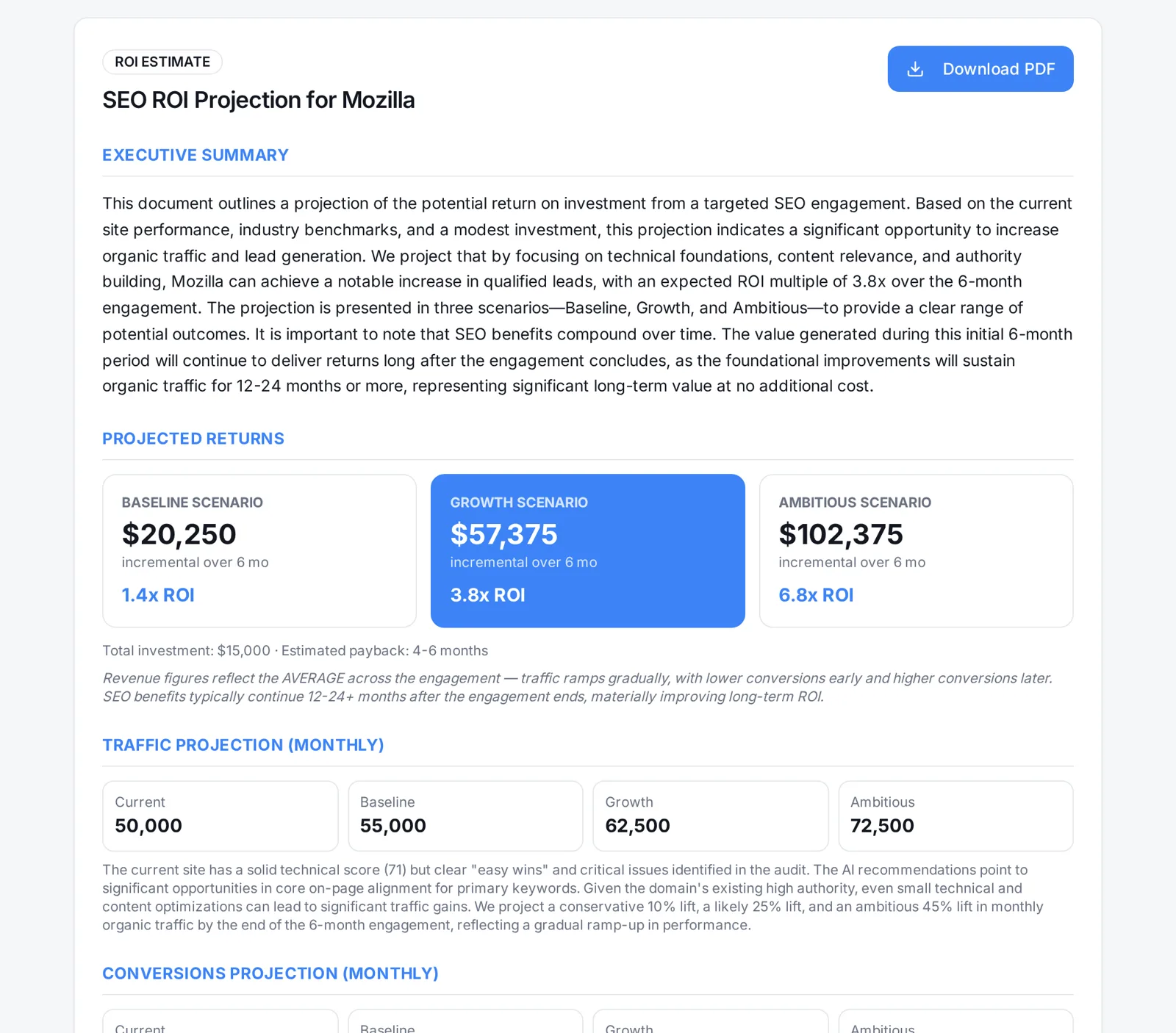
That is why a good seo roi calculator does not pretend to give a single magic number. It gives a range. A baseline scenario shows what happens if rankings barely improve. A growth scenario shows the realistic middle case. An ambitious scenario shows what is possible if execution and a few external factors break in your favor. Presenting all three is how mature teams calculate seo roi and how serious agencies communicate seo roi to clients without overpromising.
How the AeroSearchAI SEO ROI calculator works
The estimator combines three inputs: your current organic performance (pulled from Google Search Console when connected, or entered manually), your average order value or lead value, and the conversion rates you actually see on the site. From there it models keyword-level uplift potential against current positions, applies industry-aware click-through curves, and produces revenue, traffic, and lead projections across a 6 to 12 month window.
Unlike a static seo roi calculator excel template that asks you to guess every variable, this seo roi tool grounds itself in real audit data. Title tag issues, indexation gaps, and Core Web Vitals problems found by the AeroSearchAI audit influence how aggressive the growth and ambitious scenarios are allowed to be. A site with deep technical debt cannot credibly project the same uplift as a healthy one, and the model reflects that.
- Baseline scenario. Conservative: minimal ranking gains, used to set a defensible floor.
- Growth scenario. Realistic middle case based on typical 6–12 month execution outcomes.
- Ambitious scenario. Upper bound if technical fixes ship, content lands, and links accrue.
- Sensitivity inputs. Adjust CTR curves, conversion rate, and average value to stress-test the model.
How to measure SEO ROI the right way
If you are wondering how to measure seo roi after a campaign is live, the short answer is: track the same variables you forecasted. Organic sessions, assisted conversions, last-click conversions, branded vs non-branded splits, and pipeline influenced by organic landing pages are the core seo roi metrics that matter. The estimator stores your assumptions so you can compare forecast vs actual every quarter—turning a one-time pitch deck into an ongoing accountability loop.
How do you forecast seo roi without falling into vanity-metric traps? Anchor every projection to revenue or qualified pipeline, never to keywords-ranked or backlinks-built. Keywords and links are inputs; revenue is the output your CFO cares about. The seo roi forecasting model in this tool is opinionated on that point: traffic is only counted toward ROI when it has a credible path to becoming a lead or sale.
Who this SEO ROI tool is for
- SEO agencies. Use it as a sales aid to move conversations from price to value and shorten the close.
- Enterprise teams. An enterprise seo roi calculator that can model multiple business units, regions, or product lines.
- SaaS marketers. A saas seo roi calculator built around MRR, LTV, and trial-to-paid conversion, not one-off transactions.
- In-house SEOs. Justify headcount, tooling, and content budget with numbers leadership can actually evaluate.
- Consultants & freelancers. Replace the seo roi marketing calculator spreadsheet you have been patching for years.
Enterprise SEO ROI: modeling complexity without losing trust
Enterprise seo roi is a different animal. You are not forecasting one site; you are forecasting a portfolio of templates, locales, and product categories—each with its own baseline, seasonality, and competitive set. A credible enterprise seo roi calculator has to model those segments independently and then roll them up, because a single blended growth rate will always either understate the winners or overstate the laggards.
AeroSearchAI handles this by letting you run the estimator per project, per template group, or per market, then export and combine the outputs. Stakeholders see a top-line number, but every line item is traceable to a specific assumption. That traceability is what turns an SEO forecast from a sales artifact into a planning document the finance team will accept.
SaaS SEO ROI: thinking in MRR, not sessions
For SaaS, the right saas seo roi calculator does not stop at signups. It models trial-to-paid conversion, expansion revenue, and churn against a payback period. A keyword that drives 1,000 signups a month is worthless if those signups never activate; a keyword that drives 50 high-intent signups can fund an entire content team if those users convert at 30% and stick for two years.
The estimator lets SaaS teams plug in trial conversion, average contract value, and gross retention, then computes payback in months alongside 12-month and 24-month LTV-adjusted ROI. This is the model that wins budget conversations with a CFO who has seen too many SEO decks built on traffic alone.
How to communicate SEO ROI to clients and executives
Knowing how to communicate seo roi to clients is half the battle. Most prospects have been burned by an agency that promised position one and delivered a Looker Studio dashboard. The antidote is honesty up front: present the baseline scenario first, then growth, then ambitious—and explain exactly what has to be true for each to play out. Clients trust the agency that names the risks, not the one that hides them.
Inside the estimator, every projection ships with the assumptions visible: starting positions, target positions, CTR curve, conversion rate, and timeframe. When a client asks 'where did this number come from?' the answer is one click away. That transparency is the difference between a proposal that closes and a proposal that gets emailed to a competitor for a second opinion.
SEO ROI statistics worth quoting (and how to use them carefully)
Public seo roi statistics regularly cite returns of 5x to 12x on SEO investment over a multi-year horizon, with organic search driving the majority of trackable website traffic for most B2B and B2C categories. Those numbers are useful as context, but they are not a forecast. Your ROI depends on your starting point, your competitive set, and how disciplined execution is over the next 6 to 12 months.
Use industry statistics to frame the opportunity in a pitch deck, then switch to your own modeled scenarios for the actual number. Mixing the two—'the industry average is 7x, and here is what we project specifically for your site'—is far more persuasive than either alone.
Why an SEO ROI calculator beats an Excel template
Every agency has at some point built or downloaded an seo roi calculator excel file. They work, until they do not. The formulas drift, someone overwrites a cell, the CTR curve is from 2017, and the version your junior consultant sent the client is not the version your strategist signed off on. A purpose-built seo roi tool removes those failure modes by versioning assumptions, locking the math, and producing a branded export every time.
More importantly, a dedicated tool stays current. Click-through curves change as SERPs evolve—AI Overviews, more ads, more featured snippets—and a static spreadsheet has no way to keep up. The AeroSearchAI estimator updates its underlying curves and benchmarks so your forecasts reflect the SERP your client will actually face, not the one that existed three years ago.
Where to find a top agency for SEO ROI work
If you are searching for where to find top agency for seo roi engagements, the signal to look for is simple: does the agency lead with a model, or with a pitch? Agencies that open with a transparent ROI model—showing baseline, growth, and ambitious scenarios tied to your real data—are the ones who tend to deliver, because they have already done the diligence required to make the numbers stand up.
Agencies using AeroSearchAI deliver that model as part of their proposal process. If you are an agency reading this, the estimator is built so you can do the same: run an audit, plug in the prospect's numbers, and walk into the next call with a defensible forecast instead of a generic capabilities deck.
Frequently asked questions about SEO ROI forecasting
- How accurate is an SEO ROI forecast?. A good forecast is a range, not a point. Expect the growth scenario to land within ±20% over 12 months when execution is on track.
- How long until SEO ROI shows up?. Most sites see meaningful organic lift between months 4 and 9, with compounding returns from month 12 onward.
- Can I calculate SEO ROI without Search Console?. Yes—manual inputs work, but connecting GSC produces a tighter forecast grounded in real impressions and CTR data.
- Does this work for local businesses?. Yes. Plug in service area, average job value, and close rate; the model handles low-volume, high-value keyword sets well.
- Can I white-label the report?. Yes. Agencies can export the ROI report with their own branding for client proposals and quarterly reviews.
Get started with the SEO ROI estimator
Open a project, connect Search Console if you can, enter your average order or lead value, and the estimator will generate your first three-scenario forecast in under five minutes. Whether you are pitching a new retainer, defending an existing budget, or planning next year's organic channel, the goal is the same: replace guesswork with a model everyone in the room can trust.